Thursday, 29 October 2020

National and Montana Wildlife Federations Rededicated to Bison Restoration


National and Montana Wildlife Federations Rededicated to Bison Restoration

Especially on the Charles M. Russell National Wildlife Refuge

The National Wildlife Federation and its affiliated Montana Wildlife Federation, with a panel discussion internet-broadcasted on October 18, restated their commitments to restoring public-trust, wild bison in Montana, noting that the Charles M. Russell National Wildlife Refuge (CMR) offers “a unique opportunity” among America’s public lands.

These organizations have quietly supported Montana bison restoration in recent years. Recent emphasis of the National Wildlife Federation has been for more bison herds on Native American reservations. Although the CMR is the largest federal refuge within the historic range of plains bison, but lacks this keystone native species, most national and state conservation organizations have been avoiding clear support for a CMR bison herd. Bison for the CMR has been carefully sidestepped to avoid confrontations with the public-lands livestock industry.

Panel member, Montana Senator Pat Flowers noted that bison restoration has been more challenging, politically and socially, than reintroduction of wolves or recovery of grizzly bears. Tom France, Regional Executive Director for NWF, described Montana bison restoration as a “matter of public will”. He and Flowers recommended bison restoration be accomplished “the Montana way” with lots of local public input. However, Flowers noted there is a lot of public misinformation to be dealt with, and France supported face-to-face discussions of the problems. Flowers noted that anti-bison legislation may again be introduced in the 2021 state legislative session, suggesting that cross-party support for bison could be developed with candid discussion of the issues.

Panel member Mary Zeiss Strange, bison rancher from southeast Montana described bison as remarkable animals. Frank Szolloci, Executive Director of MWF, recognized the Montana Wild Bison Restoration Coalition and indicated MWF would be preparing a framework document soon.

Strong support of NWF and MWF for bison on the CMR is a significant step forward. These organizations have resources and contacts to create needed discussion and progress. Since polls show that 70% of Montana voters support restoration of public-trust, wild bison on the CMR, other conservation organizations should follow their lead.


Thank you,

Jim Bailey, Montana Wild Bison Restoration Coalition


Tuesday, 8 September 2020

Ancient DNA Documents Lost Bison Genetics


 Before and during the 1800s, North American plains bison barely survived a severe population bottleneck, declining from about 30 million bison spread across much of the continent to a few hundred animals saved from 5 or 6 local populations. While the remaining bison seemed to contain considerable genetic diversity, the amount of diversity lost with the bottleneck remained largely unknown.

However, a recent Park Service study, in cooperation with the University of North Dakota, suggests, not surprisingly, that abundant genetic diversity has been lost. The incomplete study has not been peer reviewed. Preliminary results are available on the Theodore Roosevelt National Park website. Non-nuclear mitochondrial DNA was analyzed from 67 extant bison and from bones of 73 bison recovered from archeological sites, representing pre- and post-bottleneck bison from across the country.

Researchers identified 43 different genetic groups of bison. Of these, only 10 were represented in today’s bison. The indicated loss of 76 percent of genetic diversity will compromise the ability of plains bison to adapt to changing environmental conditions, and to respond effectively to future disease challenges.

For the past 140 years, plains bison have been living in relatively small, genetically isolated herds. Small herds have continued to slowly lose genetic diversity through a process called genetic drift. Recently elevated awareness of this dilemma has prompted much official concern for the management, not just of bison, but of bison genetics. Maintaining the remaining genetic diversity of plains bison will require restoration of some large bison herds on large, diverse and wild landscapes.

Restoration of bison on the Charles M. Russell National Wildlife Refuge, a goal of our Coalition, will greatly improve the national management and preservation of plains bison genetics. This National Park Service study demonstrates the urgency of that restoration.


Thank you,

Jim Bailey, Montana Wild Bison Restoration Coalition

Monday, 27 July 2020

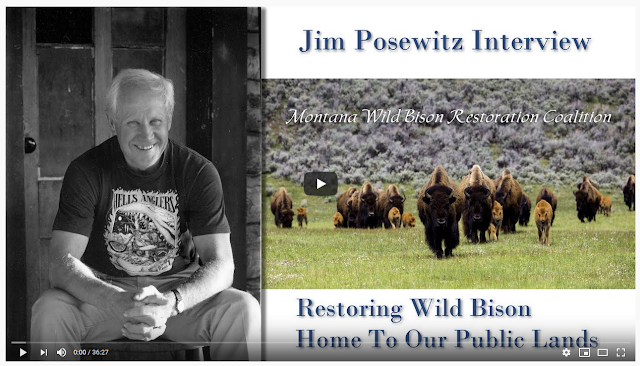
Coalition Video: Posewitz Tribute, Supporting Bison on the CMR Refuge


https://www.youtube.com/watch?v=by5Gx2YNm2Q

 Click on image to view the video in Youtube

As noted on our home page, the Coalition has just released a 36-minute video featuring the late Jim Posewitz, Montana wildlife conservationist and advocate for ethical hunting practices. Jim passed away recently and we were fortunate to have just interviewed him regarding his support for restoring public-trust, wild bison on the Charles M. Russell National Wildlife Refuge. Members of Jim’s family, Gayle Joslin and Clayton DeSimone, contributed to the production.Thank you to Gayle, for the use of some images of Poz. Thank you to Clayton, for the use of his composition, Ode To The Rocky Mountain Front, one of Poz's favorite songs.
Montana and its wildlife have lost a treasured friend in Jim Posewitz. We hope this video will serve as a tribute to his life and memory.
When you have a bit of time, view the video. There is much there about developing the public-trust concept for wildlife management and some history of efforts within Fish, Wildlife & Parks to restore public, wild bison. In the closing, reflect upon Jim’s commitment as you are treated with one of Jim’s favorite pieces of music – a piece that he once said: “sounded like the Rocky Mountain Front”. 

Thank you,
Jim Bailey, Coordinator 

Friday, 3 July 2020

Montana Politics Threaten any Future for Public, Wild Bison


Primary elections are over. Now, we move toward November elections that will finalize members of the Montana legislature to meet early in 2021. It will be a critical year, determining any future for restoring public-trust, wild bison in our state, particularly on the Charles M. Russell National Wildlife Refuge. The 2021 legislature could extinguish any possibility for public, wild bison in Montana, with little public awareness or input. With all the important competing political issues currently facing the state and nation, the issue of a bison future may be determined with little public understanding and attention. It is therefore imperative that we begin now to stimulate public discussion of the many issues, including truths and myths, surrounding bison restoration.
We have recently sent letters to each candidate for the Montana House of Representatives and Senate, requesting them to consider the issue of bison restoration and to promote public awareness and discussion. We noted the following justifications for restoring public, wild bison within the CMR Refuge:
The Montana Constitution mandates preventing unreasonable degradation of a natural resource, restoring historic, cultural and recreational objects for use and enjoyment by the people, and preserving the opportunity to harvest wild game. These mandates must include wild bison.
The national goal to restore and maintain genetically diverse plains bison is severely constrained by not allowing bison on the CMR Refuge, the largest federal refuge within the historic range of plains bison. Moreover, the Refuge goal of restoring natural biological processes cannot be fulfilled without bison restoration. The Refuge plan welcomes the opportunity to work with Montana in developing a plan and analysis for restoring wild bison on the Refuge.
Polls have shown that 70 percent of Montana voters support restoration of bison on the CMR Refuge.
Legislative guidelines protect and indemnify private property and resources in any bison restoration project.
There is a very large, unmet demand for hunting and harvesting bison in Montana. (There were over 18,000 applications to harvest a bison near Yellowstone Park in 2019.)
Restoring a public-trust, wild bison herd within the CMR Refuge can enhance and diversify economic opportunities in and near Phillips County.
Montana Fish, Wildlife & Parks, with many years of diverse public outreach and inputs, concluded in a Record of Decision that bison management issues can be successfully addressed at a landscape scale and therefore solicited site-specific proposals from Montana citizens.
We encourage our readers to challenge their political candidates to address these issues in their election campaigns and in developing platforms for November. An important part of our wildlife heritage depends upon it. 

Jim Bailey 

Wednesday, 17 June 2020

Large Unmet Demand for Bison Hunting


Recently noted statistics indicate that Montana has a large unmet demand for public bison hunting and harvesting.
In 2019, Montana Fish, Wildlife & Parks received over 18,000 applications, each with a $10 non-refundable fee, for only 93 available licenses to harvest a bison near Yellowstone National Park. Over 17,000 of these applications were from Montana residents.
Also in 2019, American Prairie Reserve conducted a higher-quality bison hunt adjacent to the area pertinent to the Coalition’s goal of restoring public-trust bison on the Charles M. Russell National Wildlife Refuge. Although legally classified as livestock, APR’s bison roam across a very large containment area, much like wild bison. In a less publicized process (compared to FWP’s license process), APR offered 16 permits, at $300 each, to harvest bison. They received 2,500 applications.
This huge unmet demand for bison hunting/harvesting indicates one large potential in restoring a public, wild bison herd on the CMR National Wildlife Refuge:
to provide opportunities for recreational hunting, including cooperative family hunts that share and benefit from the large effort needed to put hundreds of pounds of meat for many Montana dinner tables;
to enhance local economies with monies spent by resident and non-resident hunters for transportation, food and lodging;
to provide opportunities for guiding, outfitting and carcass retrieval/processing businesses in rural areas.
Furthermore, the data indicate that proceeds from state license sales could provide much or all the income needed by Montana FWP to fund the management needed, under state law, for any newly established public, wild bison herd.
(Montana has not restored a public, wild bison herd. Hunted bison from Yellowstone Park are seasonal visitors from Wyoming. Human predation has long been a predominant selective force that created the modern bison species (see “Bison Hunting & Wildness”). Thus, carefully managed hunting is a management tool that would complement other natural selective forces, maintaining the wild bison genome.)

Jim Bailey,  Coordinator